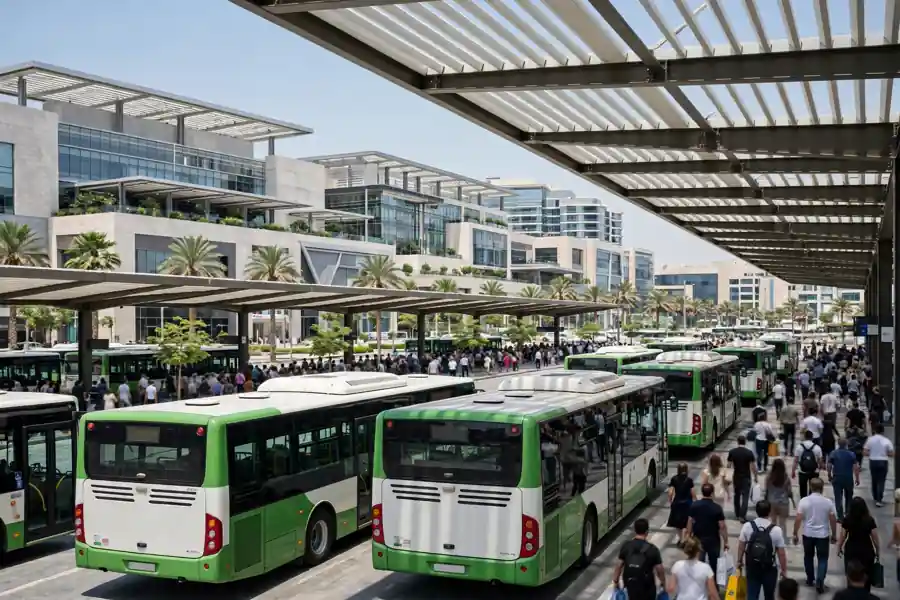
There is no Metro in the capital, so the bus Abu Dhabi runs on is the whole public transport network — and it is a big one: city routes across the island and suburbs, regional coaches to Al Ain and Al Dhafra, a non-stop express service for commuters, and intercity links to Dubai, Sharjah, Ajman and Ras Al Khaimah. Everything is organised by Abu Dhabi Mobility (the Integrated Transport Centre, ITC) and almost everything is paid for with one smart card, the Hafilat card. This hub guide explains how the network fits together, exactly how the distance-based fare works, where the main stations are, and links down to every Abu Dhabi station and intercity guide on this site.
The one rule that catches visitors out: Abu Dhabi buses do not accept cash, and the fare is charged by distance — so you must tap your Hafilat card in when you board and out when you leave. Get those two habits right and the rest of the system is simple.
| Abu Dhabi Bus — Quick Facts | |
| Operator | Abu Dhabi Mobility (Integrated Transport Centre — ITC) |
| Network | City routes · A-routes (airport & suburb corridors) · regional X-routes · Abu Dhabi Express · Abu Dhabi Link on-demand |
| Payment | Hafilat card — cash is NOT accepted on standard buses |
| City fare | AED 2 boarding + 5 fils per km, capped at AED 5 (journeys over 60 km) |
| Hafilat card price | AED 10 (anonymous card) — from stations, machines and partner stores |
| Children | Age 10 and below ride free |
| Journey planner | Darbi app and website — routes, live times and stop information |
| Express exception | Abu Dhabi Express buses charge a flat AED 12, paid in cash |
| Official site | admobility.gov.ae |
How the Abu Dhabi Bus Network Is Organised
Abu Dhabi Mobility’s network has four layers, and the route code tells you which layer you are looking at.
| Layer | What it does | Examples |
| City routes (numbers) | The everyday network across Abu Dhabi island, Khalifa City, Mussafah, Yas and the suburbs | 102, 210, 216, 222, 401–405 |
| A-routes | Corridor routes serving Zayed International Airport and the mainland suburbs | A1 and A2 (airport), A10, A40 |
| Regional X-routes | Long-distance services inside the emirate — to Al Ain and the Al Dhafra towns | X90 (Al Ain), X60 (Liwa), X62 (Madinat Zayed) |
| Abu Dhabi Express (E-0x) | Non-stop commuter coaches from the suburbs to Central Bus Station — flat cash fare | E-01, E-02, E-03, E-04 |
On top of the fixed routes sits Abu Dhabi Link, the emirate’s on-demand minibus service: book in the Abu Dhabi Link app and a small bus collects you corner-to-corner inside the covered districts — Abu Dhabi Mobility lists areas including Yas Island, Saadiyat Island, Al Shahama and Al Samha — for a flat AED 2 a ride. It plays the same first-and-last-mile role as Dubai’s Bus On Demand, feeding the fixed network rather than replacing it.
One naming trap: the intercity coaches to Dubai carry RTA’s E100, E101 and E102 numbers, which look like Abu Dhabi Express codes but are a different system entirely — different operator, different card (they take Dubai’s Nol, not Hafilat, and not cash). The intercity table below keeps them apart.
Hafilat Card and Abu Dhabi Bus Fares
The Hafilat card is Abu Dhabi’s answer to Dubai’s Nol: a rechargeable smart card used on every standard Abu Dhabi Mobility bus in the capital, Al Ain and Al Dhafra. The anonymous card costs AED 10 and is sold at bus stations, sales and recharge machines, Customer Happiness offices and partner retailers such as Lulu and SPAR. Top up at the same places, through the TAMM platform, or at machines before you board — you cannot pay or top up on the bus itself.
The fare is where Abu Dhabi differs from Dubai’s zone system. There are no zones: you pay for the distance you actually travel.
| Fare element | Charge |
| Boarding fee | AED 2 |
| Distance charge | 5 fils per kilometre travelled |
| Maximum fare | AED 5 — the fare stops rising on journeys over 60 km |
| Children aged 10 and below | Free |
| Transfers | No second boarding fee if you tap into the next bus within 60 minutes (up to two transfers; intercity services excluded) |
Distance charging is why tapping out is compulsory. Tap in at the front reader when you board and tap out at the exit reader when you leave; the system measures the trip and deducts AED 2 plus 5 fils per kilometre. Forget to tap out and the maximum fare is applied instead. Most city rides therefore cost AED 2–4, and even a long suburban run never exceeds AED 5. Abu Dhabi Mobility also sells 7-day and 30-day passes loaded on the Hafilat card, which beat the per-ride fare quickly if you ride daily — check current pass prices in Darbi or TAMM before buying, as pass pricing is revised from time to time.
Three services sit outside the standard Hafilat fare, and mixing them up is the most common payment mistake in the emirate. Abu Dhabi Express coaches charge a flat AED 12 in cash — Hafilat is not the payment method there. Long-distance regional routes such as the X90 to Al Ain charge their own set fares (AED 25 for Al Ain) on Hafilat rather than the capped city formula. And the intercity coaches run by other emirates’ operators — RTA’s E100/E101/E102 to Dubai, SRTA’s 117 to Sharjah, Ajman’s Masaar services — each take their own card or cash, detailed in the intercity table below. A Hafilat card alone does not get you to Dubai.
Two card details worth knowing. Beyond the anonymous card there is a personalised Hafilat card, registered to you — the version to hold if the card carries a pass or a meaningful balance. And the card’s stored value is capped: Abu Dhabi Mobility currently sets the maximum balance at AED 150, so there is no benefit in loading more than a few weeks of travel at a time; check your balance in TAMM or at a machine before a long regional trip, because a card that cannot cover the fare will not let you board.
Planning an Abu Dhabi Bus Journey: Darbi
The official planner is Darbi, Abu Dhabi Mobility’s journey-planning service, available as an app and on the web. Darbi builds door-to-door journeys across the bus network, shows the stops near you, gives departure and arrival times for your route, and carries service updates when routes are diverted. It is also the natural home for checking where your nearest stop is — pair it with our bus stop near me guide for the practical side of finding and using a stop. For card services — balance, recharge and pass purchases — the TAMM platform and the Hafilat web services handle what Darbi does not.
One habit separates smooth Abu Dhabi journeys from frustrating ones: because so much of the network runs at modest frequencies outside the city core, plan by the timetable rather than by turning up. Darbi’s live times matter most on the regional X-routes and at the suburban stations, where a missed bus can mean a long wait — check the departure before you leave home, and aim to be at the stop a few minutes early, since buses will not wait at timing points the way a station terminus departure does.
Main Abu Dhabi Bus Stations
Almost every city, regional and intercity journey in the emirate starts at, ends at or passes through one of these stations. Each has a full guide on this site.
| Station | Where | Known for |
| Al Wahda Bus Station (Central) | Beside Al Wahda Mall, Hazza Bin Zayed Street | The capital’s main station since 1989 — E100/E101, X90, SRTA 117 and the Ajman coach all leave from here |
| Mussafah Bus Station | Mohammed Bin Zayed City (MBZ City) | The interchange officially listed as MBZ City Bus Station — E102 terminus, A10 to the airport, Abu Dhabi Express E-01 |
| Shabiya Bus Station | Shabiya districts (ME-9 to ME-12), Mussafah | The district-level guide to the same interchange and its Shabiya street stops — routes 101, 102, 104, 210 |
| Shahama Bus Station | Al Shahama / Al Bahyah | Terminus of the 210, 216 and A40 — the mainland corridor towards Dubai |
| Baniyas Bus Station | Baniyas West, on the Al Ain road side | A40 terminus and the 400-series city routes for Baniyas and Al Wathba side |
| Madinat Zayed Bus Station | Madinat Zayed, Al Dhafra | The Al Dhafra town station — X62 to the capital, X60 to Liwa calling, town routes 661–668 |
| Etihad Bus Station | Etihad Plaza, Khalifa City | Not a terminal — the kerbside stops by Etihad Plaza, served by routes 162 and 218 |
| Al Ain Bus Station | Al Ain city | The Garden City’s station — X90 to Abu Dhabi, E201 to Dubai, SRTA 118 to Sharjah |
Regional Routes and Abu Dhabi Express
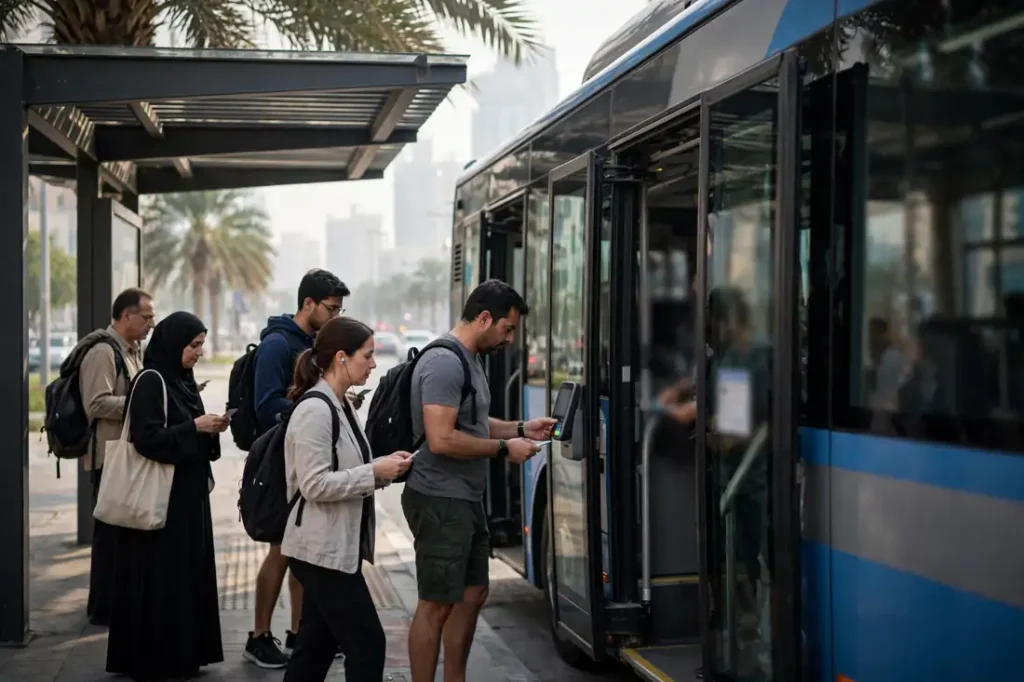
The regional X-routes are the emirate’s internal long-distance network, run on Hafilat at set fares. The flagship is the X90 between Central Bus Station and Al Ain (AED 25, roughly two hours). In Al Dhafra, the X62 links Madinat Zayed with the capital and the X60 runs between Liwa and Central Bus Station, calling at Madinat Zayed on the way; further X-routes (X86, X88 among them) serve the western corridor towns. These are working services for residents of the region rather than tourist routes, and frequencies are thinner than city routes — plan them in Darbi, not from memory.
Abu Dhabi Express is a different animal: a non-stop commuter coach service launched by the ITC in March 2022 and operated by private partners (Al Ghazal Transport and Emirates Taxi). Buses run from the suburbs straight to Central Bus Station with no intermediate stops, every 10 minutes at peak and at least every 25 minutes off-peak. The original four routes were:
| Route | From | Fare |
| E-01 | ICAD (Industrial City of Abu Dhabi), Mussafah | AED 12, cash |
| E-02 | Mussafah (Emirates Driving Company side) | AED 12, cash |
| E-03 | MBZ City / Mussafah Town Bus Terminal | AED 12, cash |
| E-04 | Safeer Mall, Khalifa City | AED 12, cash |
The launch timetable ran 5:00 AM to 10:00 PM on weekdays and until 1:00 AM on weekends and public holidays, and the network has since been extended — later routes include an E-05 towards Al Mafraq Workers City at a lower AED 10 fare, per current timetable listings. Because Express stops are unmarked kerbside points rather than stations, confirm your exact boarding point and the day’s timetable in Darbi before relying on one.
Intercity Buses from Abu Dhabi
From Central Bus Station and Mussafah, Abu Dhabi connects by coach to every other emirate except that Fujairah has no direct bus at all. Watch the payment column: this is where four different fare systems meet at one station.
| Service | Corridor | Fare | Pay with |
| E100 | Central ↔ Dubai (Al Ghubaiba) | AED 25 | Nol card |
| E101 | Central ↔ Dubai (Ibn Battuta) | AED 25 | Nol card |
| E102 | Mussafah (MBZ City) ↔ Dubai (Al Jafiliya, via Ibn Battuta) | AED 25 | Nol card |
| SRTA 117 | Central ↔ Sharjah (Al Jubail) | AED 30 | Sayer card or cash |
| Ajman direct coach | Central ↔ Ajman (Al Musalla) — 4 trips a day | AED 30 / 35 | Masaar card / cash |
| X90 | Central ↔ Al Ain | AED 25 | Hafilat card |
| RAKTA coach | Central ↔ Ras Al Khaimah (Al Hamra) — 3 trips a day | AED 35 | RAKTA booking / station counter |
| Fujairah | No direct bus — change in Dubai or Sharjah | — | See the guide. |
Journey times: Dubai is about two hours by E100/E101; Al Ain about two hours by X90; Sharjah around three hours; Ras Al Khaimah 3 to 3½ hours. For Dubai International Airport specifically, ride the E100 to Al Ghubaiba and change to the Metro — the full method is in our Dubai Bus Guide and the airport guide linked below. And for the capital’s own airport, Zayed International, the A1 and A2 buses run around the clock — covered in our Abu Dhabi Airport bus guide in Related Guides.
Beyond the Capital: Al Ain and Al Dhafra
Abu Dhabi Mobility’s network is emirate-wide, and the same Hafilat card and fare rules follow you. Al Ain, the Garden City, runs its own city network from Al Ain Bus Station and doubles as an intercity crossroads in its own right: the X90 comes in from the capital (AED 25), RTA’s E201 leaves for Dubai (AED 30), SRTA’s route 118 runs to Sharjah (AED 33), and a direct Ajman coach (AED 35) completes a set of links that lets Al Ain residents cross the country without passing through Abu Dhabi city at all. If your journey starts in Al Ain, plan it as its own hub rather than assuming a trip to the capital first.
Al Dhafra, the western region, is served more thinly — which is exactly why its stations matter. Madinat Zayed is the working hub (X62 to the capital, the Liwa-bound X60 calling, and the 661–668 town routes), and the X86 and X88 continue along the western corridor. Distances are long and departures are few, so the regional pattern is: check Darbi, travel on the timetable, and treat the station guides linked above as your fallback reference when plans change mid-journey.

Tips for Using Abu Dhabi Buses
- Tap in AND out, every time: The fare is distance-based. A missed tap-out means the maximum fare — and on a capped AED 5 system, that is the whole point of tapping.
- Keep the right card for the right bus: Hafilat for Abu Dhabi Mobility buses, Nol for the E100/E101/E102 to Dubai, cash for Abu Dhabi Express. No single card covers everything at Central Bus Station.
- Buy the Hafilat card before the airport: The A1/A2 airport buses take Hafilat only, and the airport is a bad place to discover your card is empty. Cards are sold at the airport, stations and Lulu/SPAR outlets.
- Use the 60-minute transfer: A second bus boarded within 60 minutes of tapping out carries no new AED 2 boarding fee — chain your city journeys instead of paying twice.
- Regional routes need planning: X-routes to Al Dhafra and the RAKTA and Ajman coaches run a handful of times a day. Check Darbi and be at the station early — the next departure may be hours away.
- No eating or drinking on board: As across UAE public transport, food and drink are prohibited on the bus and fines apply.
How much is a bus ride in Abu Dhabi?
AED 2 boarding plus 5 fils per kilometre, capped at AED 5 — so most city rides cost AED 2–4. Long-distance routes charge set fares instead: AED 25 to Al Ain on the X90, and the Abu Dhabi Express commuter coaches charge a flat AED 12 in cash.
What is a Hafilat card and where do I buy one?
Hafilat is Abu Dhabi’s rechargeable bus smart card, required on every standard Abu Dhabi Mobility bus. The anonymous card costs AED 10 and is sold at bus stations, sales and recharge machines, Customer Happiness offices and partner stores such as Lulu and SPAR; top up at machines, stations or via TAMM.
Why do I have to tap out on Abu Dhabi buses?
Because the fare is charged by distance: AED 2 plus 5 fils per kilometre. The system only knows how far you travelled when you tap out. If you don’t, the maximum fare for the route is deducted instead of your real fare.
Can I pay cash on Abu Dhabi buses?
Not on standard city and regional buses — they are Hafilat card only. The exception is the Abu Dhabi Express commuter service, which charges a flat AED 12 in cash. Intercity coaches run by other emirates take their own payment: Nol for RTA’s Dubai coaches, Sayer or cash for Sharjah’s.
Is there a bus from Abu Dhabi to Dubai?
Yes, three: the E100 from Central Bus Station to Al Ghubaiba, the E101 from Central to Ibn Battuta, and the E102 from Mussafah (MBZ City) to Al Jafiliya via Ibn Battuta — all AED 25 and all paid with a Dubai Nol card, not Hafilat. Journey time is about two hours.
How do I plan an Abu Dhabi bus journey?
Use Darbi, Abu Dhabi Mobility’s official journey planner (app and web): it builds the route, shows your stops and gives live departure times. For fares, remember the simple formula — AED 2 plus 5 fils per kilometre, never more than AED 5 on standard services.
Do children ride free on Abu Dhabi buses?
Yes — children aged 10 and below travel free on Abu Dhabi Mobility buses. Older children pay the standard distance fare with their own Hafilat card, tapping in and out like any other passenger.
What is Abu Dhabi Express?
A non-stop commuter coach service run for Abu Dhabi Mobility by private operators since March 2022. Routes E-01 to E-04 link ICAD, Mussafah, MBZ City and Khalifa City (Safeer Mall) directly with Central Bus Station — no stops in between, every 10 minutes at peak, for a flat AED 12 paid in cash.
Related Guides
- Abu Dhabi Airport Bus: A1, A2 & Airport Routes, Timings & Fares
- Dubai to Abu Dhabi Bus: Timings, Fare & Stations
- Al Ain Bus Station: Routes & Timings
- Bus Stop Near Me: How to Find Your Nearest Stop
- Dubai Bus Guide: Routes, Timings, Fares, Map & Nol Payment

Daniyal Sheikh
Transport Editor, UAE Travel Hub
Dubai daily commuter covering the Metro, Nol cards, RTA buses and intercity routes across all seven emirates — every fare and timing checked against official RTA, ITC and SRTA sources.