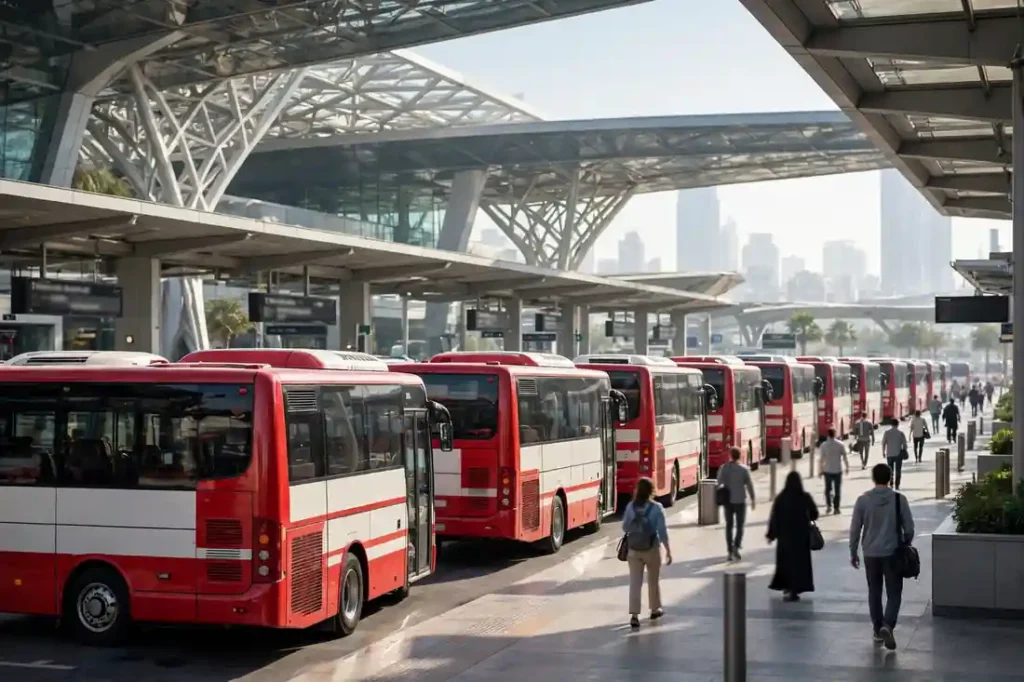
Every dubai bus — more than a hundred routes carrying hundreds of thousands of passengers a day — is run by one operator, the Roads and Transport Authority (RTA), and paid for with one card, the Nol card. That single system is what makes the network learnable: once you understand the route letters, the zone fares and the handful of big stations where everything connects, you can get almost anywhere in the emirate for between AED 3 and AED 7.50. This hub guide explains how the network is organised, what it costs, where the main stations are, and links you down to every route and station guide on this site.
Start with the letters. A Dubai bus route number is a small code: plain numbers are local routes, C routes circle the old city centre, X routes are express, F routes feed the Metro, E routes leave the emirate, and N routes run at night. Read the code and you already know what the bus is for.
| Dubai Bus — Quick Facts | |
|---|---|
| Operator | RTA (Roads and Transport Authority), Dubai |
| Network | 100+ routes: local, CBD (C), express (X), Metro feeder (F), intercity (E), night (N) and seasonal |
| Payment | Nol card only — cash is never accepted on board |
| City fares | AED 3 (1 zone) · AED 5 (2 zones) · AED 7.50 (3+ zones) on Silver / Personal Nol |
| Hours | Most routes run from early morning (around 4–5 AM) to about 1 AM · C01 runs 24 hours |
| Journey planner | S’hail app (RTA) — live departures, routes, fares and stop positions |
| Intercity | 14 E-series routes to Abu Dhabi, Sharjah, Ajman, Al Ain, Fujairah, Ras Al Khaimah and Hatta |
| Enquiries | RTA call centre 800 9090 · rta.ae |
How the Dubai Bus Network Is Organised
RTA divides its bus network into families, and each family has a job. Local numbered routes do the heavy lifting inside neighbourhoods; the lettered families layer speed, Metro connections and intercity reach on top. The table below is the whole system at a glance.
| Family | What it does | Examples |
|---|---|---|
| Local (numbers only) | Standard city routes linking neighbourhoods, stations and malls across the emirate | 8, 13D, 27, 33, 84, 93 |
| C — CBD routes | Circle and cross Deira and Bur Dubai, the historic central business districts | C01 (airport–Satwa, 24h), C26, C28 |
| X — Express routes | Fewer stops, longer distances — commuter corridors on the main highways | X13, X22, X25, X28, X92 |
| F — Feeder routes | Short loops from Metro stations into the surrounding neighbourhoods | F01, F07, F24, F30, F55 |
| E — Intercity routes | Coaches to the other emirates — full table below | E100, E201, E303, E700 |
| N — Night routes | Overnight services while the Metro sleeps | N30 (International City ↔ Airport Terminal 2) |
| Seasonal routes | Run only in season, for the big winter attractions | 105 (Miracle Garden), 106 (Global Village) |
The families are designed to combine. A typical commute is an F-route from home to the Metro, the Metro across the city, and a local or X-route at the far end — and because fares are charged by zone for the whole journey (see below), the change of vehicle does not restart the price. Intercity E-routes are the exception: they charge their own flat fares, listed in the E-route table further down.
Dubai Bus Fares and Nol Cards
Dubai is divided into seven fare zones, and the bus fare depends only on how many zones your journey touches — not on the route or the distance. You tap your Nol card on the reader when you board and again when you get off; the system works out the zones and deducts the fare. There is no cash fare on any RTA bus.
| Journey | Silver / Personal Nol | Gold Nol | Red Ticket |
|---|---|---|---|
| Within 1 zone | AED 3 | AED 6 | AED 4 |
| Across 2 adjacent zones | AED 5 | AED 10 | AED 6 |
| More than 2 zones | AED 7.50 | AED 15 | AED 8.50 |
One nuance in that table: the Gold card’s double fare buys the Gold Class cabin on the Metro and Tram — on buses there is no Gold cabin, and Gold card holders pay the standard Silver rate. The four card types are:
| Card | Price | Best for |
|---|---|---|
| Red Ticket | AED 2 (paper, plus the fare per trip) | Visitors making a couple of journeys — load up to 10 single trips |
| Silver | AED 25 including AED 19 credit | The default card for almost everyone — buy at any Metro or bus station |
| Gold | AED 25 including AED 19 credit | Metro and Tram Gold Class users; standard fares on buses |
| Personal (Blue) | AED 70 including AED 20 credit | Registered card with balance protection — and the only route to concession fares: students, senior Emirati citizens and social-affairs beneficiaries travel at 50% off |
Three rules save regular riders money. First, transfer smart: switch between bus, Metro and Tram within the transfer window and the legs count as a single journey for fare purposes. Second, tap out — the fare is only calculated when you tap off the bus; forget, and the journey stays open. Third, keep at least AED 7.50 on the card, the minimum balance the Metro gates ask for and enough for the longest bus fare. Children under 5 travel free, and People of Determination travel free with the appropriate card or permit.
Dubai Bus Timings: First and Last Buses
There is no single timetable for the network, but there is a reliable shape to the day. RTA buses as a whole operate from about 4:00 AM to 1:00 AM the following night, and most individual routes start between 4:30 and 6:00 AM and finish between 11:30 PM and 1:00 AM. Frequencies follow the commuter clock: every 10–20 minutes on busy corridors at peak, every 20–30 minutes in the middle of the day, and thinner late in the evening. Feeder routes are timed to the Metro, so their first departures line up with the first trains and their last runs meet the last ones.
Weekends and holidays shift the pattern. Friday mornings run noticeably quieter, Sunday evenings are the Sharjah corridor’s weekly peak, and RTA adjusts schedules across many routes during Ramadan — another reason the live times in S’hail, not any printed table, are the source to trust on the day. The exceptions to the whole pattern are the ones already flagged: the C01 never stops, and the N30 exists precisely for the hours everything else is parked.
Planning a Dubai Bus Journey: S’hail and the Route Map
Forget paper maps — the working tool is S’hail, RTA’s official journey-planning app. Enter where you are and where you are going and it builds the journey across bus, Metro, Tram and marine transport, with live departure times, the fare, walking legs and service alerts. It also shows the real position of stops, which matters more than visitors expect: RTA relocates stops during roadworks (the airport stops have moved more than once), and S’hail is where the current position appears first. The same planner sits on the RTA website, and the RTA Dubai app adds Nol top-up and balance services. For a printed overview, RTA publishes a network map — useful for learning the shape of the system — but always confirm a specific departure in S’hail before you leave.
At the bus stop
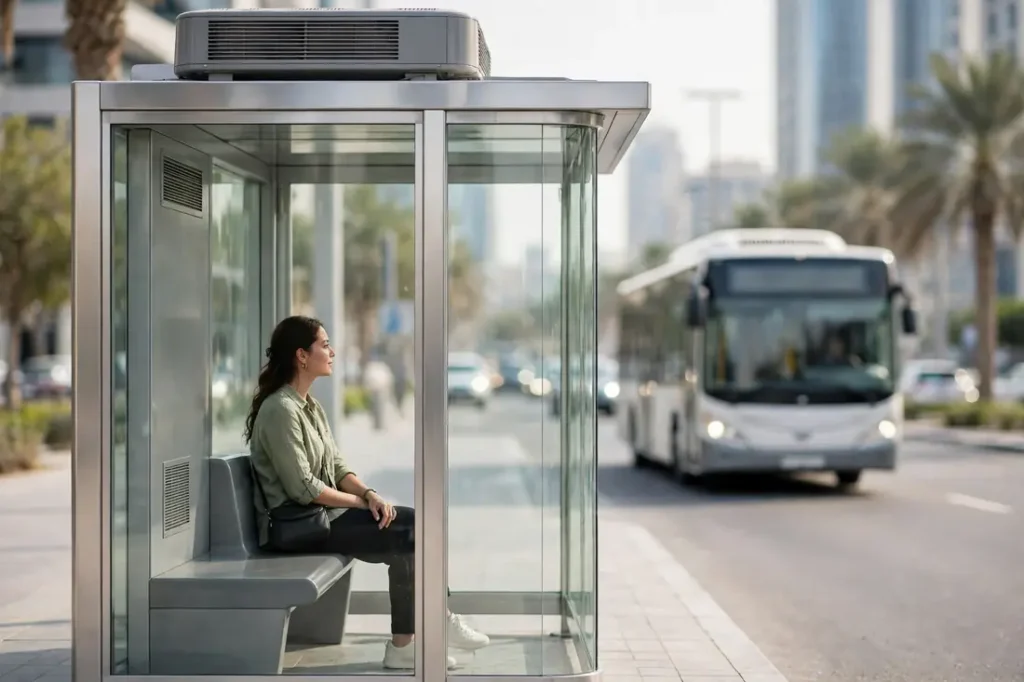
Every RTA stop carries a unique stop name and number — the same identifiers S’hail uses — and the major stops and stations have air-conditioned shelters, a small mercy in August. Board through the front door and tap in straight away; the driver cannot accept cash or sell you a card, so a stop is the wrong place to discover your Nol balance is empty. Stops on the fast corridors are request stops in practice: be visible, signal clearly as your bus approaches, and press the stop button well before your stop once on board. If your stop has been moved for roadworks, S’hail shows the temporary position — check it rather than waiting at a fenced-off shelter.
Main Dubai Bus Stations
Most journeys start or change at one of the big stations. Each has its own full guide on this site — where it is, which routes use it, what connects there.
| Station | Area | Known for |
|---|---|---|
| Union Bus Station | Deira | The intercity crossroads — E303 to Sharjah, E400 to Ajman, RAKTA coaches and a Metro interchange below |
| Sabkha Bus Station | Deira | Open-air stop cluster by the abra crossing — E303A to Sharjah, E16 to Hatta |
| Gold Souk Bus Station | Deira | The old town’s big terminus — 19 terminating routes, E306 to Sharjah |
| Al Ghubaiba Bus Station | Bur Dubai | Bur Dubai’s main station — E201 to Al Ain and Sharjah services |
| Satwa Bus Station | Al Satwa | Home of the 24-hour C01 airport bus and the 32C |
| Oud Metha Bus Station | Oud Metha | RTA’s model station by the Green Line — city routes only, no intercity coaches |
| Ibn Battuta Bus Station | Jebel Ali side | E101 and E102 to Abu Dhabi, beside Ibn Battuta Metro and mall |
| Etisalat Bus Station | Al Qusais side | Three intercity departures — E315, E411 and the E700 to Fujairah — under the Green Line terminus |
| Rashidiya Bus Station | Rashidiya | Feeder hub under Centrepoint Metro (Red Line terminus) with a large park-and-ride |
| Mall of the Emirates Bus Station | Al Barsha | Mall and Metro interchange — J01 and the seasonal Miracle Garden / Global Village buses |
| Deira City Centre Bus Station | Port Saeed | E307 to Sharjah and the airport-area stops |
| Al Qusais Bus Station | Muhaisnah 1 | Eastern terminus for routes 13A/13B/13D, 32C and 33 — near the airport and Sonapur |
| Abu Hail Bus Station | Abu Hail | Stop cluster by Abu Hail Metro — the E307A to Sharjah |
Intercity Buses from Dubai: The E-Routes
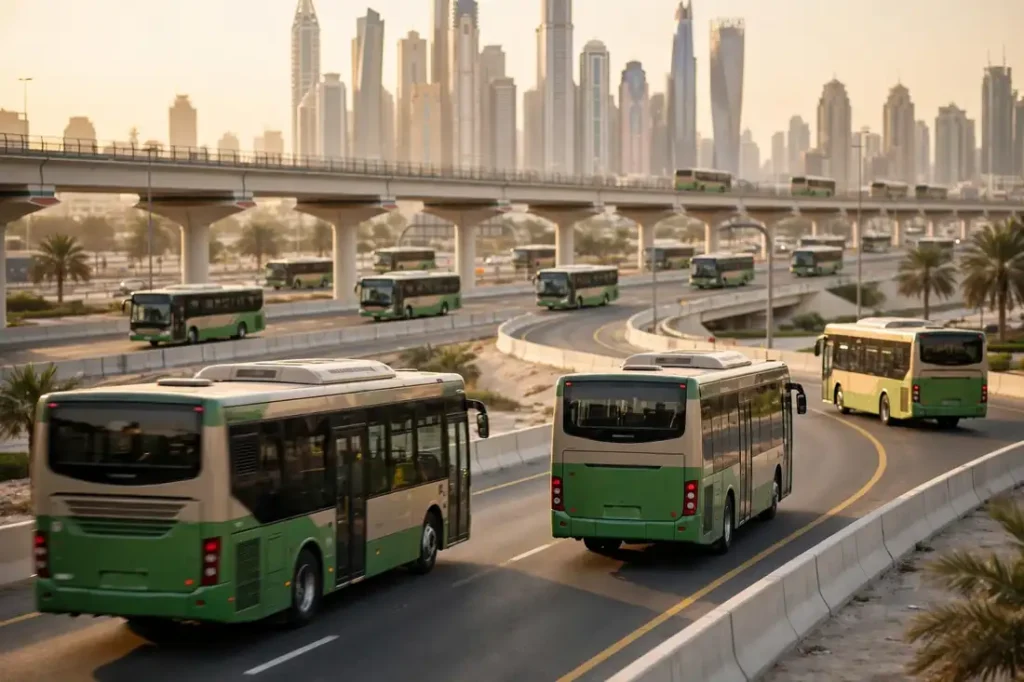
The E-series is Dubai’s bridge to the rest of the UAE: air-conditioned coaches with flat fares, all paid by Nol card (intercity coaches do not use the zone system). Sharjah routes charge AED 12 almost across the board; Abu Dhabi and Al Ain cost AED 25–30; the long Fujairah run is AED 30. Every route below has its own timetable guide.
| Route | Corridor | Fare (Nol) |
|---|---|---|
| E100 | Al Ghubaiba ↔ Abu Dhabi (Al Wahda) | AED 25 |
| E101 | Ibn Battuta ↔ Abu Dhabi (Al Wahda) | AED 25 |
| E102 | Al Jafiliya ↔ Abu Dhabi (Mussafah / MBZ City) | AED 25 |
| E201 | Al Ghubaiba ↔ Al Ain | AED 30 |
| E303 | Union ↔ Sharjah (Al Jubail) | AED 12 |
| E304 | Dubai ↔ Sharjah (Al Jubail) | AED 12 |
| E306 | Gold Souk ↔ Sharjah (Al Jubail) | AED 12 |
| E307 | Deira City Centre ↔ Sharjah (Al Jubail) | AED 12 |
| E307A | Abu Hail ↔ Sharjah (Al Jubail) | AED 12 |
| E308 | Stadium ↔ Sharjah (Al Jubail) | AED 12 |
| E315 | Etisalat ↔ Sharjah (Muweilah) | AED 12 |
| E400 | Union ↔ Ajman (Al Musalla) | AED 15 |
| E411 | Etisalat ↔ Ajman (Al Musalla) | AED 12 |
| E700 | Etisalat ↔ Fujairah | AED 30 |
Two warnings from the timetable fine print. First, do not confuse RTA’s E-routes with similarly numbered buses from other emirates — Sharjah’s SRTA runs its own numbered routes (its 308 to Jebel Ali is not RTA’s E308), and cards are not interchangeable. Second, the Dubai–Sharjah corridor is the busiest intercity run in the country: at evening peak the coaches fill and the Sharjah border traffic stretches the journey, so build in a buffer.
Night and Seasonal Buses
When the Metro closes, the network shrinks to a skeleton — but it does not vanish. The C01 keeps its 24-hour schedule between the airport and Satwa, and the N30 night bus links International City with Airport Terminal 2 via Centrepoint through the night hours. Between them, airport workers and late arrivals keep a public-transport option at almost any hour.
Seasonal routes appear with Dubai’s winter calendar. Buses 105 and 106 run from Mall of the Emirates to Miracle Garden and Global Village respectively while those attractions are open (roughly October to May), and extra Global Village services run from other hubs in season. Dates change every year — our dedicated Global Village bus guide tracks the current season’s routes.
Dubai Bus On Demand
The newest layer of the network has no fixed route at all. Dubai Bus On Demand is RTA’s app-booked shared minibus service: you enter a pick-up and drop-off inside a covered zone in the Dubai Bus On Demand app, the system groups you with passengers heading the same way, and a minibus comes to a nearby pick-up point. RTA lists 20 covered zones, including Al Barsha, Al Nahda, Dubai Silicon Oasis, Academic City, Business Bay, Downtown Dubai, Al Karama, Oud Metha, DIFC, Al Qusais, JVC, Dubai Investment Park, Al Satwa, Al Quoz and Mirdif.
The fare is AED 5 per passenger per trip (reduced to AED 2 within the Business Bay zone), paid inside the app by card or ride credits — it sits outside the Nol fare system, so a Bus On Demand ride does not combine with a Metro or bus fare as one journey. You can book for up to six people in one ride. It is best thought of as a first-and-last-mile tool: the cheap way to cover the awkward kilometre between your building and the Metro station, in districts the fixed routes thread through thinly.
Trips are normally contained within one zone, but some neighbouring zones can be crossed in a single booking — the app shows whether your pair of zones qualifies and prices the trip before you confirm. Bookings are made for a specific pick-up point rather than your exact doorstep, so expect a short walk at one or both ends; the app shows the bus location, seat availability and estimated arrival while you wait.
Dubai Bus or Metro: Which Should You Use?
They are one system with one card, so the real question is which vehicle suits each leg. The Metro wins on its own corridors — Sheikh Zayed Road and the Deira–Bur Dubai spine — because it is fast, frequent and immune to traffic; if your journey starts and ends near stations, ride the train. The bus wins on reach: it serves the neighbourhoods between stations, the industrial areas, the beaches’ back streets and every address the railway never touched, and it keeps running for roughly two hours after the last train. Most residents mix them without thinking — feeder bus, Metro, walk — and because the fare is calculated across the whole journey by zone, mixing costs no more than the zones you cross. Visitors staying near the Red Line will ride the Metro most; visitors heading to the old town’s lanes, Jebel Ali or the airport’s Terminal 2 will find the bus doing work no train can.
Dubai Bus Rules and Tips
- Front door in, tap in; tap out when you leave: Board by the front door so the driver sees your Nol tap. The fare is calculated at tap-out — skipping it leaves the journey open.
- No eating or drinking on board: RTA bans food and drink on buses, as on the Metro, and fines apply.
- Priority and ladies’ seating: The front rows are signed for women, children and People of Determination — the driver can ask you to move, and regulars simply respect it.
- Let the bus stop fully: Signal with the stop button in good time; drivers cannot brake safely for a last-second ring on the fast X and E routes.
- Keep AED 7.50 minimum balance: It clears the Metro gates and covers the longest zone fare, so a low card never strands you mid-journey.
- Friday mornings are quiet, Sunday evenings are not: Frequencies thin early on the weekend and coaches to Sharjah fill on Sunday evening — check live times in S’hail rather than trusting the printed headway.
How much is a bus ride in Dubai?
By zone: AED 3 within one zone, AED 5 across two adjacent zones and AED 7.50 for more than two, on a Silver or Personal Nol card. Intercity E-routes charge flat fares instead — AED 12 to Sharjah, AED 25 to Abu Dhabi, AED 30 to Al Ain and Fujairah.
Can I pay cash on a Dubai bus?
No. Every RTA bus is Nol card only — there is no cash fare and no card reader for bank cards on board. Buy a Silver Nol card (AED 25 including AED 19 credit) at any Metro or bus station, and tap in and out on every ride.
What do the letters on Dubai bus routes mean?
C routes serve the central business districts of Deira and Bur Dubai, X routes are express services with fewer stops, F routes are Metro feeders, E routes are intercity coaches to other emirates, and N routes run at night. Plain numbers are standard local routes.
Which Dubai bus runs 24 hours?
The C01, between Airport Terminal 3 and Satwa Bus Station via Terminal 1 — it is the network’s only round-the-clock route. The N30 also runs through the night between International City and Airport Terminal 2.
How do I check Dubai bus timings?
Use the S’hail app: it shows live departures, builds journeys across bus, Metro and Tram, and flags stop relocations and disruptions. The RTA website has the same journey planner, and each station and route guide on this site lists the service pattern for its route.
What is Dubai Bus On Demand?
RTA’s app-booked shared minibus service, operating in 20 zones including Al Barsha, Business Bay, Downtown, JVC and Al Qusais. It costs AED 5 per passenger per trip (AED 2 within Business Bay), is paid in the app, and is designed for first-and-last-mile trips to Metro stations.
Do Dubai buses go to other emirates?
Yes — the 14 E-series intercity routes link Dubai with Abu Dhabi (E100, E101, E102), Sharjah (E303–E315), Ajman (E400, E411), Al Ain (E201), Fujairah (E700) and, via the RAKTA coaches, Ras Al Khaimah. All charge flat Nol fares; the full table is above.
Is the airport on the Dubai bus network?
Yes. The C01 serves Terminals 1 and 3 around the clock, and routes 31, 43 and C26 serve Terminal 2, with the N30 at night. Our Dubai Airport bus guide covers every route, fare and the Abu Dhabi connection in detail.
Related Guides
- Dubai Airport (DXB) by Bus: C01 & Airport Bus Routes, Timings & Fares
- Global Village Bus: Routes, Timings & Fares
- Bus Stop Near Me: How to Find Your Nearest Stop
- Abu Dhabi Bus Guide: Routes, Timings, Fares & Hafilat Payment
- Dubai to Abu Dhabi Bus: Timings, Fare & Stations

Daniyal Sheikh
Transport Editor, UAE Travel Hub
Dubai daily commuter covering the Metro, Nol cards, RTA buses and intercity routes across all seven emirates — every fare and timing checked against official RTA, ITC and SRTA sources.